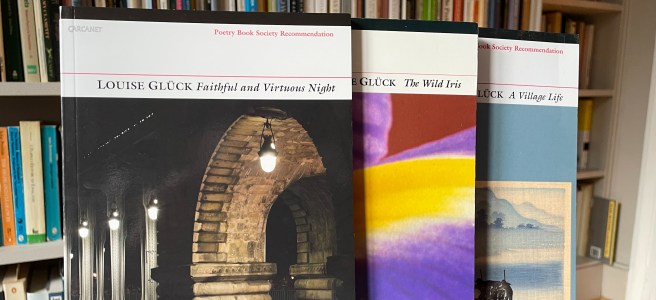
The choice of Louise Gluck for the Nobel Prize was unexpected, but immediately felt right, to me at least. I find her poems haunting, like lucid dreams, particularly in ‘Faithful and Virtuous Night’ (2014).
The New York Review of Books featured her Nobel lecture (undelivered because of Covid) ‘The Poet and the Reader’. She writes more as a reader than a writer. And it’s a particular kind of poem she likes to read. This is about encountering Blake and Shakespeare (songs from the plays) as a child;
‘I was drawn, then as now, to the solitary human voice, raised in lament or longing. And the poets I returned to as I grew older were the poets in whose work I played, as the elected listener, a crucial role. Intimate, seductive, often furtive or clandestine. Not stadium poets. Not poets talking to themselves’
(Interesting to be thinking about this both before and after Amanda Gorman’s remarkable performance at Biden’s inauguration)
This is Gluck’s question after winning the Nobel (with reference to Emily Dickinson) ; ‘What happens to a poet of this type when the collective, instead of apparently exiling or ignoring him or her, applauds and elevates? I would say such a poet would feel threatened, outmanoeuvred.’
‘Those of us who write books presumably wish to reach many. But some poets do not see reaching many in spatial terms, as in the filled auditorium. They see reaching many temporally, sequentially, many over time, into the future, but in some profound way these readers always come singly, one by one’.
And so we do. I like Gluck’s protective recognition of how we read most of the time, book in hand, alone. But we also like to know we’re not the only ones.

 the word-road home