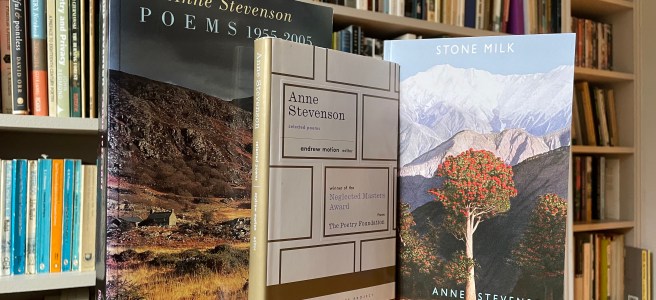
I very much appreciated the two-page eulogy for Anne Stevenson (1933-2020) by John Lucas in Poetry Nation Review 257. The first Stevenson volume I came across was Minute by Glass Minute (1982), which I liked initially because much of it was about the Black Mountains and the Welsh border country. I was also drawn to her later landscapes; Dundee, Durham, North Wales. And of course she was the co-founder of the Poetry Bookshop in Hay-on-Wye (best poetry bookshop in the world, as far as I know).
She’s a poet that grows on you steadily, who sticks around in your mind; mainly, I think because her sense of pitch is so good, the instinct for the right length of line, the way a phrase or word should land with respect to sound and rhythm.
From ‘Pennine’ (in Minute by Glass Minute)
Everything trains to the perpendicular.
Trees stand taller on one green root than another.
The village is slabbed like steps into its slope,
Its churchyard paved with graves, thronged with unbalanced
Mitred headstones, an asylum of bishops. The dead
Are unsafe. Their graves hardly hold them.
And this is from ‘A Lament for the Makers’, a poem from ‘Stone Milk’ (2007), in which she imagines meeting the spirits of Peter Redgrove, Frances Horovitz, Ted Hughes, Sylvia Plath, Edward Thomas, Dylan Thomas amongst others:
But now it’s here,
the season of deciduous souls,
gold smouldering to umber
when the sun illuminates
briefly that reredos of beeches
with Byzantine fire.
A last, late finger of grace
still brightens far reaches
of a barbarous empire
lyrically and lovingly.
Most of what we write
time will erase.
Listen to those sequences of long vowels; souls, gold, smouldering, ……last, late, grace
Anne Stevenson is also a very good writer of prose about the craft of poetry. Consider these quotes.
‘The poet has to rely upon instinct to break through logic, and instinct appears to be a mixture of acute awareness (particularly of speech-sounds) and sheer luck..’
‘It sometimes happens that a poem….. writes itself almost by accident while I am trying to write something else.’
‘Each new poem offers a fresh challenge, and unless my ear takes it on… my will can do nothing. A poem can take months, years, to find its right form. Sometimes, with luck, it can fall into shape in hours.’
‘Nothing in my experience is more important about the writing of poems than that they should surprise you. That while you are submitting to their rigorous demands of rhythms and sounds they find a way of saying things you never meant to say, or never knew you knew’
The first three are from her chapter in ‘How Poets Work’ (1996 Ed. Tony Curtis), which also contains 11 pages of her draft poems, handwritten or typed with hand corrections.
One gripe. ‘Poems 1955-2005’ is organised by theme; Seven Ages, The Art of Making, Border Crossings etc. When I looked back through it I realised how much I want the poems to be placed in time. I want to know when they were written, to see the development, trace the story of a writing life. You can find out which collection the poems come from by cross-checking with the index, but that’s not easy with a Bloodaxe doorstop. Her selected poems in the American Poets Project (Ed. Andrew Motion) has fewer poems and no dates, but it is ordered chronologically.

 the word-road home