I’ve been following Ian Brinton’s account (in PNR 256 and 257) of the fortunes of the Grosseteste Press and Review from the late sixties to the mid-eighties. It was one of the wave of small, underfunded, brave poetry ventures of those decades, featuring writers who were of little interest to the larger publishers. Two quotes from the article have stayed with me.
This is Tim Longville, poet and editor, in a letter from 1983: ‘No books sell now. I don’t mean that they fail to sell out, I mean that to all intents and purposes they sell no copies at all. Certainly they do nothing like cover their costs. If anything, the ‘audience’ gets smaller with each attempt to tap it.’
And this is from Gordon Jackson’s account of two presses: ‘..there was a hope and a struggle, in which participants saw themselves as amateurs and had no dreams of rewards, but who did what they did because it was a good thing to do..’.
Many of us have been there, one way or another; writing, art, music, politics etc. I applaud all such seemingly hopeless projects.
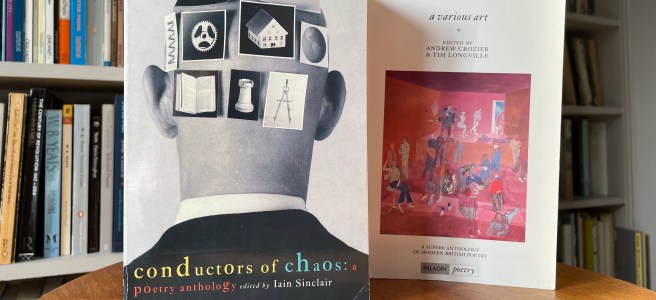
I have two anthologies which gather a good number of the poets published by small presses from the sixties through to the nineties; ‘a various art’ from 1987, edited by Andrew Crozier and Tim Longville, and ‘Conductors of Chaos’ (1996), edited by Iain Sinclair. The 1996 volume was also a re-introduction to some neglected poets from previous generations.
Lee Harwood, John James, Barry MacSweeney, J.H.Prynne, Denise Riley, Peter Riley, Roy Fisher, Veronica Forrest-Thomson; those are the poets I’ve read beyond the selections in the anthologies, in some cases because they’ve been published more prominently since then. For the rest, I don’t think I’d want more (some of it is, in Sinclair’s words from his introduction, just too ‘remote, alienated, fractured’ for me) but I’m glad to have them on the shelf. There are some that I just don’t understand or know how to read, but I retain the hope that I will get it one day.
Iain Sinclair’s introduction to ‘Conductors of Chaos’ is a little classic of semi-affectionate invective, an anthologist’s warning against anthologies. It’s worth quoting from.
‘The anthology is, essentially, a compromise: that undesirable thing by which poetic generations are defined. A scratch selection, hoping, against all previous experience, to transform itself into something more than the sum of its disparate parts’
‘A Various Art……sounded too much like a tea-chest of unattributable dross in a poorly attended Fenland auction.’
‘I bless them. They will recall their contributions to the anthology a dozen times, just to remix the spacing. They make impossibly complex demands on the typesetters, reams of precise and insane instructions. It matters so much, life and death: the furies have to be appeased/antagonised on a single page. This poem is the last that will ever be written.’
And then, questions to come back to another time: ‘If these things are difficult, they have earned that right. Why should they be easy? why should they not reflect some measure of the complexity of the climate in which they exist? why should we not be prepared to make an effort, to break sweat, in hope of high return?’

 the word-road home