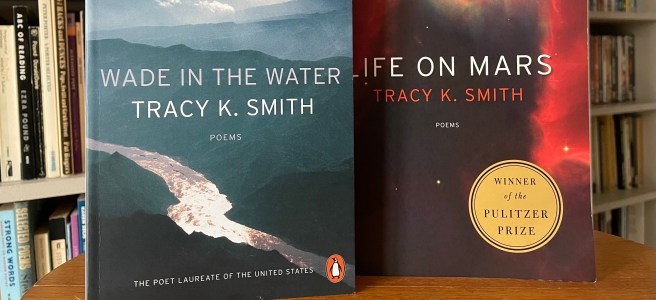
Tracy K. Smith’s ‘Wade in the Water’ (2018), her first UK publication, contains her powerful ‘erasure poems’, using historical texts from the American civil war. “I Will Tell You the Truth about this/I Will Tell You All about It” is a series of poems composed of letters and statements from African Americans enlisted in the civil war, their wives and families. Kate Kellaway, in her Guardian review wrote: ‘I found myself wondering whether these were poems at all – and whether it matters. Their power to move is obvious, the injustices suffered undimmed by time..’
There is sometimes a feeling that urgency, importance, relevance should trump all questions of form and genre, must make those issues beside the point. But I think these are poems, and that it matters.
Fred D’Aguiar said, about his own use of found sources:
‘you want to see what poetry can do in negotiation with the text – what is it that the poem can do without surrendering all its ground to understanding – it had to chant, it had to sing in some way’. (Poetry London. Spring 2019)
You could put the question in a slightly different way. What is it that poetry does that prose does less well? I think here that it’s something to do with Tracy K Smith’s poems being ‘abridged’ (though we don’t know at what point, or how much) and with the effect of turning prose statements into a poetic line. What’s written in the poem has been selected; the phrases resonate in the white spaces at the end of lines, in the middle of lines, between sections. (I have had to put dotted lines in the internal white spaces – the blog programme wants to close them down)
Mr abarham lincon
I won’t to knw sir if you please
whether I can have my son relest
from the arme…………………he is all the subport
I have now……………………his father is Dead
and his brother that wase all
the help I had…………………….he has bean wonded
twise he has not had nothing to send me yet
Interestingly, our uncertainty, as to whether any individual poem has been abridged or not, means that we play with the possibility that there was more, even if the statement seems self-contained.
A poem has the particular quality that it is not a logical argument. It doesn’t have to make a case in court, explain itself in a lesson or be an accurate historical record. In the gaps in our understanding or knowledge, the gaps in the syntax, in the empty spaces – we are free to make of it what we will.
‘ a poem is a shape, a set of lines or frontier on what is not said’.
(Angela Leighton ‘On Form’)
It could be argued that these are not really poems, or not Tracy K Smith’s poems because they are not her own words (and certainly not her own spelling). But I think the impact comes from the choice of words, of how to abridge, how to place phrases on the page and where to leave emptiness. A poem is partly about not having to use all the space you’ve got.
Mr president……………….. It is my Desire to be free………………..to go to see my people
on the eastern shore…………… my mistress won’t let me……………….you will please
let me know if we are free………………… and what i can do

 the word-road home