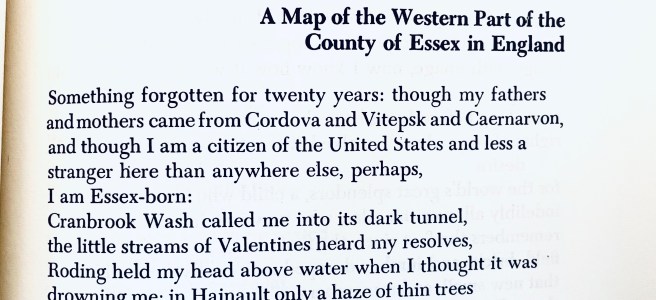
Sometimes, if I see an old poetry book going second-hand, I will buy the volume for the pleasure of seeing a favourite poem in its original form – font, paper, placement on the page and in the book. I have a thin copy of Denise Levertov’s ‘The Jacob’s Ladder’, a New Directions Paperbook (not paperback) from 1961, bought in the wonderful Brattle Bookshop in Boston (Massachusetts).
It’s a superb poem about origins, about the multiplicity of the answers to the question ‘Where are you from?’ – in her case ‘Cordoba and Vitebsk and Caernavon’, as family history, and Essex, where she spent her childhood. Levertov makes the past glow, as if it were only a step away:
In Hainault only a haze of thin trees
stood between the red double decker buses and the boar-hunt,
the spirit of merciful Phillipa glimmered there.
….In
Ilford High Road I saw the multitudes passing pale under the
plight of flaring sundown, seven kings
in somber starry robes gathered at Seven Kings
the place of law
where my birth and marriage are recorded
and the death of my father.
I now know, having recently read Derek Pearsall’s biography of Chaucer, that ‘Phillipa’ evokes Philippa of Hainault, the queen of Edward 111. And that ‘Havering -atte- Bower’ (in the poem) was the site of a royal palace. Part of my affinity for the poem comes from my own childhood in a suburb of London – Eltham – which was also the location of a royal palace. Pearsall describes the king in the 1360s ‘showing an increasing inclination to stay for longer periods with his private household in his favourite country houses at Eltham, Sheen, Langley, Havering or Moor End’
But it’s also a poem about a map, and about a child who reads atlases. As a walker since adolescence, I always loved maps, and I notice poems that notice maps. There’s Eavan Boland’s ‘That the science of Cartography is limited’ and Kei Miller’s ‘The Cartographer Tries to Map a Way to Zion’. Miller’s whole book is an argument with the map-maker, but at least he’s worth arguing with. There’s David Constantine’s most recent book, ‘Belongings’ with a geological map of Salford on the cover.
Levertov’s poem contains within it a sense that the map will change, that her childhood landscape had been and would be increasingly absorbed within London. The poem ends with building materials – ‘that new smell’ – and it is a childhood that can only be remembered from afar – America – on a map. It was also a childhood in which the poet used maps to imagine future experiences. In fact, the end of the poem brings all this together so beautifully I simply want to quote it:
‘All the Ivans dreaming of their villages
all the Marias dreaming of their walled cities,
picking up fragments of New World slowly,
not knowing how to put them together nor how to join
image with image, now I know how it was with you, an old map
made long before I was born shows ancient
rights of way where I walked when I was ten burning with desire
for the world’s great splendors, a child who traced voyages
indelibly all over the atlas, who now in a far country
remembers the first river, the first
field, bricks and lumber dumped in it ready for building,
that new smell, and remembers
the walls of the garden, the first light.’

 the word-road home