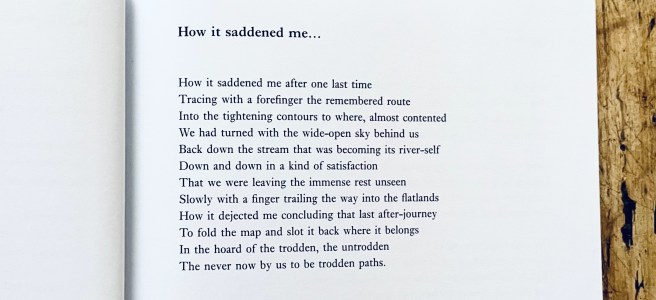
And more again about map-making and poetry. I’ve been reading section 1 of David Constantine’s ‘Belongings’. These half a dozen poems are a hymn of gratitude for walking, for the landscapes of Northern England and for the folded map. I’m reading them having just returned from walking Hadrian’s Wall and the Northumberland coast.
The long lines of the first poem ‘My recent encounter with the Good Angel’ – hover above the landscape like a cartographer:
‘ 13.
The terrain was intricately I folded and my vision felt for me in among the curving possibilities.
14.
I felt how they pushed in, forked, opened, ratified ever more finely climbing.
15.
I saw ways of exploration without paths.
16.
For the lie of the land itself, its own suggestions, its bidding and encouragement would suffice.’
The poem ‘Maps’ knows that, for the map-reader the map is the souvenir. The landscape can be sensed, recreated through the pattern of the contours.
‘Reading the map afterwards
Assures us of our hinterland, all we got by heart
Through our boot-soles from the braille of the terrain
And all that our fingers learned by digging in
And hauling up our bodyweight. There it is
Our route, very public, anyone can follow it
But only the walkers know it for a song-line
With undertones. Thanks be then to the makers
Of agreed markers, conventional signs..’
The poem ‘How it saddened me…’ is in the photo above; the realisation, with age that some paths may never be explored, or may have been trodden for the last time.
It is part of the purpose of writing to say ‘For me, it was like this’. And it is one of the pleasures or reading to say ‘It’s like that for me, too’, and to feel a frisson of recognition that someone else has noticed this small thing. In fact, the existence of the poem affirms that this was a thing worth noticing. For which, thanks to David Constantine.

 the word-road home