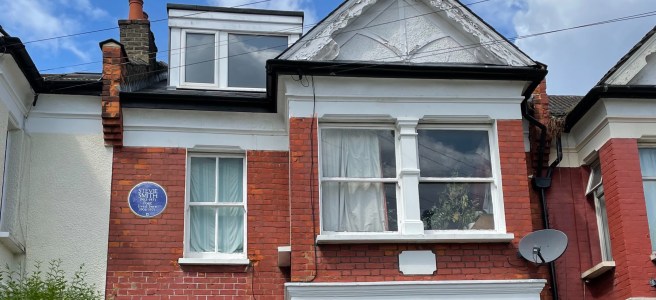
A couple of weeks ago I took the tube, then walked to Palmers Green to find the house – 1 Avondale Road – where Stevie Smith lived from the age of three (1906) until her death in 1971. She lived there with her mother, sister and aunt, latterly becoming sole carer for her aunt. It’s a late-Victorian house, at the end of the road but not classically end-of-terrace because a larger house is positioned at the street corner.
It was a house of female habitation,
Two ladies fair inhabited the house,
And they were brave. For although Fear knocked loud
Upon the door, and said he must come in,
They did not let him in.
The home is now deep in the heart of North London suburbia, but when she first moved there from Hull it was right at the edge of London. Even in 1920, if you look on the Mapco website, the countryside started just two streets away, thick woodland on the west side of the railway line. In her biography, Frances Spalding writes about the young Stevie and her sister, Molly:
‘though Stevie and Molly were forbidden to cross the railway line that edged the woods, they soon found a culvert under the line and crawled through……..they enjoyed outwitting the keeper whose business it was to keep the children out, for these woods were then still privately owned and trespassers forbidden’
In Smith’s own words;
‘Paradise… was that part of the wood which lay just behind the railway cutting, an open pleasant place it was with a little stream, all open and sunny as the day itself. But behind that again lay the dark wood, with the trees growing close together, the dark holly trees, the tall beeches and the mighty oak trees’
The references to forests in her poems have an enchanted quality, like something out of a ballad or a fairy-tale, as well as her typical deliberate oddity of phrasing;
‘I rode with my darling in the dark wood at night
And suddenly there was an angel burning bright
Come with me or go far away he said
But do not stay alone in the dark wood at night
My darling grew pale he was responsible
He said we should go back it was reasonable
But I wished to stay with the angel in the dark wood at night
……………
There was a light burning in the trees but it was not the angel
And in the pale light stood a tall tower without windows
And a mean rain fell and the voice of the tower spoke,
Do not stay alone in the dark wood at night.
Stevie Smith’s childhood woods are almost all gone now. The area to the west of the railway line is a series of interwar streets. It would have all disappeared but for Southgate Urban District Council stepping in to buy 91 acres in 1921, which became Grovelands, Smith’s favourite park. Other built-up areas retain the memory of forests in their names; Oakwood, Arnos Grove, Wood Green. Every suburban location is also a sub-rural place, or perhaps ex-rural. It is worth thinking of Smith as one of those writers, like Ruskin or E.M.Forster, who in their lifetime saw their childhood countryside swallowed up by the enlargement of towns and cities.

 the word-road home