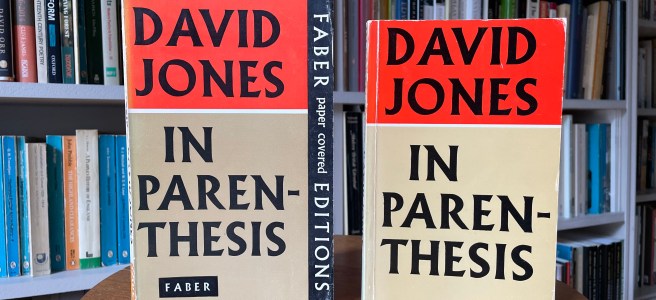
Ive been interested in the recent articles at the back of PNR about book design – interviews with Phil Cleaver and Sarah Schulte. It’s led me to compare editions, where I have two copies of the same book. Here is David Jones’ ’In Parenthesis’, one of the great long poems of the twentieth century; the copy on the left from 1963, on the right from 1978.
I prefer the 1963 edition. It’s a little taller and wider, and the extra space gives wider margins around the blocks of text, allowing them more room to breathe. In addition, the 1978 copy has slightly thicker paper, which means you have to wrench the spine open to a greater extent to read the internal line endings/beginnings. The 1963 copy opens more at its ease, so to speak.
This might seem like nit-picking, but Jones was a visual artist too, acutely conscious of the look of the words on the page. We know from Thomas Dilworth’s biography that there were problems with the first edition: ’In Parenthesis was badly set, as noticed by reviewers, who complained of words eliding, making reading difficult. This was the fault of the Temple Press setting machines…. Physically, the book was not clearly readable’
Lack of readability, books that don’t open properly – I find that even with contemporary publications there are books I give up on because the words are placed like an obstacle course. Picador are one of the main culprits. I’ve been trying to read ’Whereas’ by Layli Long Soldier, but it has thick pages, a stiff spine and words placed with no margin so they disappear down into the valley between the pages. A book should be a pleasurable object, good to look at, straightforward to read, comfortable in the hand. And then we can think about whether it’s worth reading.

 the word-road home