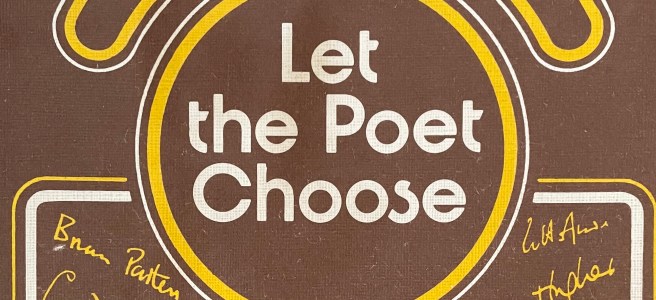
I have a liking for old poetry anthologies from secondhand shops, for saving them from oblivion, from the bottom of the poetry detritus pile. They are always a reminder of how precarious poetic reputations are, how little we know of who will last from our current favourites.
I picked up ‘Let the Poet Choose’ (edited by James Gibson) from a bookshop in Falmouth at New Year. It’s from 1973, looks like a school anthology and has an authentically 70s dull brown cover. The idea is that each poet has chosen and introduced two of their own poems. Alphabetically organised, always the most democratic arrangement.
There are some who clearly stand out, whose poems and reputations are still alive; Thom Gunn, Seamus Heaney, Ted Hughes, Philip Larkin, Stevie Smith, R.S.Thomas and W.H.Auden (even in his late period lower-wattage mode). There are others whose standing may be lesser, but they are important to me; Elizabeth Jennings, Charles Causley, Norman Nicholson.
There are good poets who have not made great choices for this book; Robert Graves, Dannie Abse, Peter Porter, Charles Tomlinson. Poets are not always the best judge of their own work. Graves says “The two poems are new ones and all I can say about them is that nobody ever wrote them before I did”. Well, true.
One of the distinct pleasures of the book is the unexpected poem, by a supposedly minor poet, which still leaps off the page, either in whole or in particular stanzas. Vernon Scannell and Edmund Blunden both choose poems revisiting war memories (The Second World War for Scannell, the First for Blunden). This is the end of Scannell’s ‘Walking Wounded’:
‘Not one was suffering from a lethal hurt,
They were not magnified by noble wounds,
There was no splendour in that company.
And yet, remembering, after eighteen years,
In the heart’s throat a sour sadness stirs;
Imagination pauses and returns
To see them walking still, but multiplied
In thousands now. And when heroic corpses
Turn slowly in their decorated sleep
And every ambulance has disappeared
The walking wounded still trudge down that lane,
And when recalled they must bear arms again.’
(“Walking Wounded I like….. because it was so damned hard to write. I did – if I remember rightly – eleven versions of it before I got it to its final form”
This is the start and end of Blunden’s ‘Can You Remember?’
Yes, I still remember
The whole thing in a way;
Edge and exactitude
Depend on the day.
…………………………………….
New-old shapes for ever
Intensely recur.
And some are sparkling, laughing, singing,
Young, heroic, mild;
And some incurable, twisted,
Shrieking, dumb, defiled.
(“My experiences in the First World War have haunted me all my life and for many days I have, it seemed, lived in that world rather than this.”)
It is a surprise to find that Laurie Lee, author of the sun-drenched ‘Cider with Rosie’ and ‘As I Walked Out one Midsummer Morning’, also chooses a poem of personal anguish – ‘Black Edge’
I lie no more in a healthy sheet,
a wind of chill eyes makes a marsh of my cheeks,
diseased is my sleep with demented sound
and I am infected by the stars.
For see how the sun rubs ulcers in the sky
how black as bats the field flowers droop and fall;
the earth, the sweet earth,
is foul and full of graves.
O save me, for I am sick;
lay on my eyelids your finger’s miracle,
bewitch me that I may live… ‘
(‘it was a direct cry made at the edge of breakdown, and one which, because I was able to make it, may have saved me at the time’)
Lest it be all distress, I would also pick out an untitled poem by Kathleen Raine. It would be easy (I’m tempted) to dismiss this as old-fashioned, a period piece. But I am touched by it, and I’m only really uncomfortable with the third line. I think the poem is an attempt to describe something we might now be too embarrassed to name this way. She uses the word ‘daimon’ where we might be more inclined to say ‘idea’, ‘impulse’, ‘imagination’. This is the whole poem:
Long ago I thought you young, bright daimon,
Whisperer in my ear
Of springs of water, leaves and song of birds,
By all time younger
Than I, who from the day of my conception
Began to age into experience and pain;
But now life in its cycle swings out of time again
I see how old you were,
Older by eternity than I, who, my hair gray,
Eyes dim with reading books,
Can never fathom those grave deep memories
Whose messenger you are,
Day-spring to the young, and to the old,
ancient of days.
Having highlighted some of the good stuff, I should note the downside. Of 44 poets, I’d say half fall short; they fail to leap the five decades and make a claim to my attention. This includes formerly esteemed poets like Lawrence Durrell, Roy Fuller, C Day-Lewis, Anne Ridler and Stephen Spender. However, the poets’ introductions may be worth quoting, even if their poems are not. I’ll turn to the poets’ prose in my next post.

 the word-road home
Very enjoyable and thought-provoking as always. Makes me want to dig out some of my dad’s old anthologies.
LikeLike
Thanks John
Sent from my iPhone
<
div dir=”ltr”>
<
blockquote type=”cite”>
LikeLike