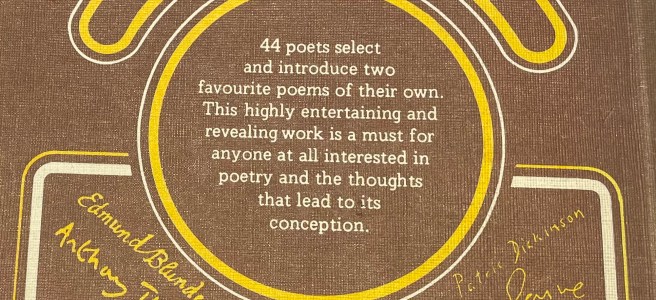
Let the Poet Choose, a 1973 British anthology in which each poet chooses two of their own poems and introduces them. As I said in my previous post, even where the poems don’t convince me, the prose can still be intriguing, the sound of poets trying to make sense of themselves.
There are some interesting attempts to describe the art, to say what it feels like to write a poem, or to have written one:
Dannie Abse: ‘This poem still surprises me when I read it. It seems to me to be cleverer than I am, more lyrical than I am, more pessimistic than I am’
Ted Walker: ‘I discovered that, for me, a poem is not so much a means of saying what I think as finding out what I knew only dimly to be on my mind. If I already know what I want to say, I don’t bother trying to make a poem of it; there’s no mystery left, and therefore no interest to me.’
Kingsley Amis (yes he was a poet once) ‘I suppose the most obvious reason why a poet prefers some of his poems to others is that he, by definition, is the only one who knows the more or less completely successful effort from the only partly successful. (If he has any sense, he doesn’t let anybody see the really unsuccessful.) ‘Success’ here means, of course, not the achievement of a great poem, or even a good one, but success in the poet’s own terms; in other words, having put into verse exactly what he meant to say in just the way he intended.’ (A rather different approach to Ted Walker’s)
There are several poets who feel they’ve been badly treated or misunderstood by publishers, reviewers or readers. Certain poems or books need to be brought forward like neglected siblings.
Charles Tomlinson: ‘These two poems, together with another, ‘Prometheus’, are a trilogy in a sense: they occupy the moral centre of all that I have done. Reviews of The Way of the World (their context) totally ignored them.’
R.S.Thomas: ‘I offer ‘Love’ and ‘Those Others’ both from my third book Tares. I would choose these as a reminder of the existence of Tares, which for some reason appears to sell less well than my other books.’
Peter Porter: ‘These poems may seem a little esoteric but I have tried to explain them in this note. I feel, perhaps over-sensitively, that I am often misrepresented in anthologies.’ (To adopt a politician’s maxim, if you’re explaining, you’re losing..)
Some poets are very straightforward in their introductions, almost shockingly blunt. Elisabeth Jennings’ comment is about her poem ‘For a Child Born Dead: ‘I choose the first of these because it was written in a quite different way from my usual habit. My sister lost a baby and, four days later, I wrote this poem straight, with scarcely any alterations at all.’ John Betjeman writes ‘My second poem ‘Remorse’ comes straight from the heart. It is about a death-bed scene at which I was present.’ The poem is as raw as the explanatory sentence. (More about both these poets in a future post)
Larkin’s preamble is a reminder of what a good prose writer he is. You have to acknowledge how wry and witty he can be, even when you’re arguing with him. His first comment might belong with the resentful trio above, except that he mocks himself so neatly:
‘I looked through my three books of poems, and after some time came to the conclusion that I was subconsciously looking for poems which did not seem to me to have received their due need of praise. Of course, there were quite a lot of them, and selection was difficult………. I have always believed that beauty is beauty, truth truth, that is not all ye know on earth nor all ye need to know….One of the jobs of the poem is to make the beautiful seem true and the true beautiful, but in fact the disguise can usually be penetrated.’
Stevie Smith is very pleased with her own poem ‘The Ass’. And why not? It’s very good, peculiar and haunting in her typical manner. Perhaps most poets feel this way, but she’s the only one who says so in quite this fashion:
‘’I often have the idea in my poems of Death as a friend. Sometimes it is a very buoyant idea of Death. As if he were a god, bringing extreme happiness, opening gates, setting us free…….. I think the line ‘Paradise, Paradise’ is quite breathtakingly beautiful. I also like the swish and smash of the sea running in over the saltings and crashing on the sandhills of the distant coastline, as it does on the coastline of North Norfolk by Blakeney Point. How strong this poem is, how it draws one….’
Like with Stevie Smith, the most endearing (and enviable) comments are the ones expressing sheer pleasure in writing, or in getting published. These two also remember the delight of beginning, the first glimmer of recognition from others (and from oneself).
Roy Fuller: ‘ “Poem”:was published in New Verse in December 1934. For an unknown provincial young man, to achieve publication in a first-class avant-garde magazine…..came as an excitement and encouragement scarcely to be experienced again (I should add that the poem has never since been reprinted).
Ted Walker: ‘This was among the first poems I wrote, then, to be seen in public. While it was being made I discovered how immensely difficult the craft of poetry is, and to what extent an artist depends on some measure of good luck – recognising the happy accident, that is, and turning it to his advantage….. when it was finished, I knew at once that it was the real thing, that this was what I’d always do…… in both poems there are terrible weaknesses which I don’t think I can do anything about. They were damned hard work and left me spent.’
I don’t care much for Ted Walker’s poems, but I like his honesty.
,

 the word-road home