’It’s almost impossible to say why certain music attracts me, or interests me, and other things leave me cold. The process of criticism is heavily dependent on a rationalisation of subjectivity. As a critic, you can spend your life prioritising your own tastes with increasingly elaborate intellectual justifications that disallow any alternatives’. That’s David Toop, and allowing for the fact that he’s writing about the most experimental and improvised end of music, for music read poetry.
The American poet G.C.Waldrep says that poems talk to one another – this poem placed next to that poem – in a book or poetry magazine. Quotes do that too. I jot useful sentences down in a notebook; David Toop’s comments found themselves opposite this from Kay Ryan:
“I found my title ‘That Will to Divest’ in an essay by Milan Kundera. Kundera was saying something admiring about the modern composer Leos Janacek, how Janacek was trying to write music in a new, denser way. But did I care? No. It was that simple radiant – possibly radioactive – phrase that I loved. I don’t know why writers go to such pains to make sense when somebody like me is just going to come along and read their work like a crow looking for shiny objects.”
’That Will to Divest’ isn’t one of my shiny objects, it means nothing to me, but Kay Ryan’s thoughts do. We take whatever we can get from poems, we find our own way in, using any foothold that’s available. There are no Olympian heights. What else could we do but rationalise our subjectivity? It’s the only place we can read from, and come back to. And then we find out whether it’s the same, or not, for others.
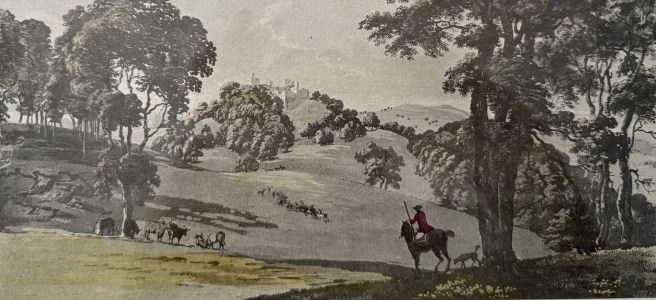
I’ve been reading G.C.Waldrep’s first book to be published in the UK, ‘The Earliest Witnesses’ (2021). Much of it baffles me, but near the end are a group of poems written in and about landscapes of South Wales; ‘Llandyfeisant Church’, ‘Castle Woods, Dinefwr’, ‘Dryslwn’, ‘Llandeilo Churchyard’. I know these places well! They’re all in one small area where I’ve been half a dozen times – that’s Dinefwr castle and woods in the image above. It gives me a way in. Waldrep is a walker, as am I, and I recognise the rhythm of a mind simultaneously drifting and paying attention to particulars –
‘A spindle-whorl. A spool. Dog-rose in flower at the Tywi’s
edge. You may make an image if you like. The sheep do it.
Ants do it in and through their labors, their chemical mazes.
It is time, my friend said, to reckon our exhaustion, to tote it up.’
It always is, as a walker. However beautiful the landscape, you need food and water, rest, attention to your feet. And in Waldrep’s case, these walks came in the wake of serious illness, when he wondered at times if there would be another walk.
Does this help me with the earlier poems in the book? Not really, not yet, but I have a foothold. Waldrep talks online about listening to the radio as a child, trying to pick up signals from Mexico and the Caribbean. He says poetry is like this – sometimes you succeed in getting on the right wavelength. It all depends how much static you can tolerate.
Here’s David Toop again on improvised jazz. ‘It embodies a way of living that is necessary, even if only for a minority, and so it persists as anomaly, as conscience, as critique and as refuge’. I appropriate that quote for poetry.

 the word-road home