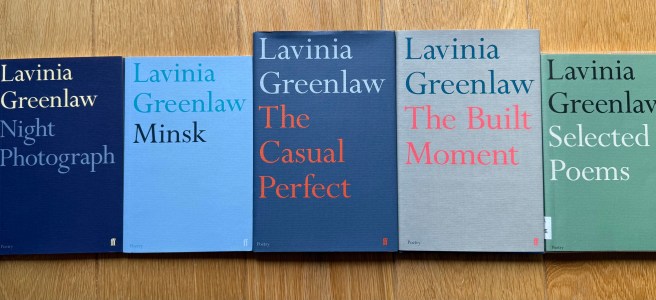
If a Selected Poems has an introductory note, it’s usually not very instructive, but Lavinia Greenlaw’s comments are genuinely interesting: ‘A poem is sudden and then it is slow. It continues to move between these two states while I try to keep up with its swerves or chip away at each impasse. When a poem completes itself, I feel something relax: it’s holding itself in tension and I can let go now. But completion is not usually the end of the matter. The poem has found a reliable form only perhaps not the right one. As a collection starts to gather, which for me takes about seven years, the poems talk to each other behind my back and cast a new light.’
If the poems talk to each other, so must the separate books within a Selected, while the deselected poems are outside complaining about their exclusion. I bought most of Greenlaw’s collections when they came out; she’s been a favourite for a long time, and each new volume casts a different light on the preceding ones. But a Selected Poems is a different matter; you begin to see the whole pattern, the arc of the writing life. I first began to take notice of Lavinia Greenlaw just over twenty years ago, with the publication of ‘Minsk’ (2003). It’s where she started to foreground Essex, her place of teenage exile from London. There had been ‘Estuary’ in ‘Night Photograph’ (1993):
‘black Essex mud
refuses to take shape
I can live with this promise
that nothing is in place
but everything is here’
Now there was ‘The Long Day Closes’, ‘Essex Rag’, ‘Blackwater’, ‘Clownfish’, ‘Zombies’; the Selected Poems makes you notice these as a group by winnowing out other subjects (the sequences about the Lofoten Islands and London Zoo, her version of Dante etc). In Greenlaw’s version, she had been dragged from the excitements of London to a quiet village – ‘to the fields of our years of boredom…/ Did we not remember the curse of this place?’. No doubt a teenage hell, but rich material; it’s where she comes home, poetically, where her work starts to feel grounded, rooted in rootlessness.
’The times I tried to move on….
But from here, I mean there, wherever
you get to is not far, still nowhere, so
there’s nothing for it but to head home,
unsure whether the last bus has gone.’
’Nowhere’ is a great starting point, and we are still there, much of the time, in ‘The Casual Perfect’ (2011). But it’s done with increased concision, with shorter, end-stopped lines:
’He walks his mind as a forest
and sends of himself into dark places
to which he cannot tell the way. ‘ (Actaeon)
’Each night another room grows empty.
I find myself mostly outside.
The howling mansion.
The hyper-dimensional wood.’ (Dreams of Separation)
“we travelled with such speed and force
the driver threw the reins aside:
‘Everything that’s for us is against us.
We’re going nowhere tonight’ “ (Coleridge)
Then in 2019 came her most powerful, haunting work yet; ‘The Sea is an Edge and an Ending’, the first section of ‘The Built Moment’, a sequence of 24 poems about her father’s dementia and death. Spare, short, honest, and at times quite devastating:
’What unlocked this emptiness?
He knows not to ask. He knows now how small he is,
how small his island, how small his spell.’
The Selected Poems has 6 of the poems. I wish it could have all 24, and keep them as a unit, but it would overbalance the book. Of the ones that have been chosen, read ‘My father cannot stop’ or ‘My father tells me to wait’.
I’ve moved past one book in my account; ‘A Double Sorrow: Troilus and Criseyde’ (2014). I’ve praised it in a previous post, and I still admire it, but here it feels like an anomaly. They aren’t quite Lavinia Greenlaw’s poems, they’re versions of Chaucer. He begins to sound like her, of course, but it’s Chaucer nonetheless. On the other hand, this is one of those places where the collections start talking to each other. Here is Troilus, from ‘A Dead Image’:
’His mind can do nothing with this
So carries it off. Mindless
He makes his way home, bolts the door
And puts out every lamp in his chamber
As if plucking the last bright leaves
From the blackest tree in winter.
He is branch and bark – the barest dark.’
And this is the poet’s father from ‘My father tells me to wait’, in ‘The Built Moment’.
’He peers at me and the space between us extends itself
so that I am where he wants me, out there in the dark
in a place without stars or fathers
and he raises his hand and says ‘Stay there, stay there.’
I won’t say that they sound like the same poem, but they are surely akin. That’s what a Selected Poems can do: two unconnected poems sounding similar, linked together across five years in just a few turns of the page.

 the word-road home