Two weeks ago, in Somerset I made a visit to East Coker, the village where T.S.Eliot’s ashes are buried, and the title for the second of his Four Quartets. The church has a small display (see photo above) in a corner next to the memorial plaque for the poet and his second wife Valerie. Eliot … Continue reading ‘The dancers are all gone under the hill’
Author: daveevaphotograms
Poems from New Writing 1936-1946
It was an Islington Oxfam Bookshop buy; ‘Poems from New Writing 1936-1946’, selected by John Lehmann, with a front cover image by John Minton. New Writing was an anti-fascist magazine of the 30s (Lehmann also put together the anthology Poems for Spain) which became Penguin New Writing at the start of the war years. Lehmann, … Continue reading Poems from New Writing 1936-1946
‘Nightmarishly pleasurable’
At the beginning of July, in the New York Review of Books, there was a wonderful poem by Fernando Pessoa, the Lisbon poet who split himself into four different poets; three pseudonyms and his own name (which has an air of anonymity about it, Pessoa meaning ‘Person’ in Portuguese). This poem was in the voice … Continue reading ‘Nightmarishly pleasurable’
‘The trouble with poetry is that it encourages the writing of more poetry’
In Susan Sontag’s ‘On Photography’ (1977) she quotes Hannah Arendt writing about Walter Benjamin: “nothing was more characteristic of him in the thirties than the little notebooks with black covers which he always carried with him and in which he tirelessly entered in the form of quotations what daily living and reading netted him in … Continue reading ‘The trouble with poetry is that it encourages the writing of more poetry’
‘Lectures I will never give’
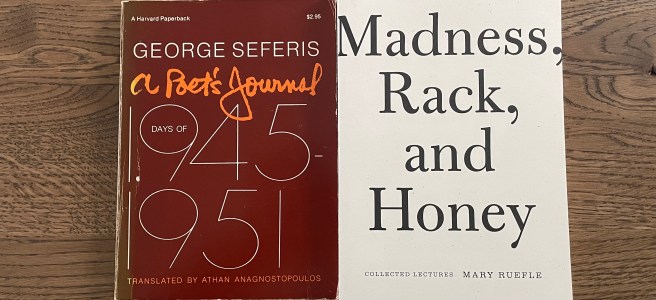
An curious coincidence. Last Saturday, at the Oxfam bookshop in Greenwich, I bought ‘A Poet’s Journal’ by George Seferis. It begins shortly after the liberation of Greece at the end of World War 2 and goes through to 1951, years of the Greek Civil War. It is, in part, Seferis’s own internal conversation with Cavafy. … Continue reading ‘Lectures I will never give’
‘breakers that chuff; long, leaden swells of pewter’
I took this photo a couple of weeks ago, in the Caribbean. It’s Derek Walcott’s childhood home in Castries, St Lucia. I had some Walcott with me; I like to read poets in their own territory. I’ve read Pablo Neruda in Chile, Robert Lowell in Boston, Dylan Thomas on the Gower Peninsular and, to give … Continue reading ‘breakers that chuff; long, leaden swells of pewter’
‘Cleverer than I am, more lyrical than I am, more pessimistic than I am’
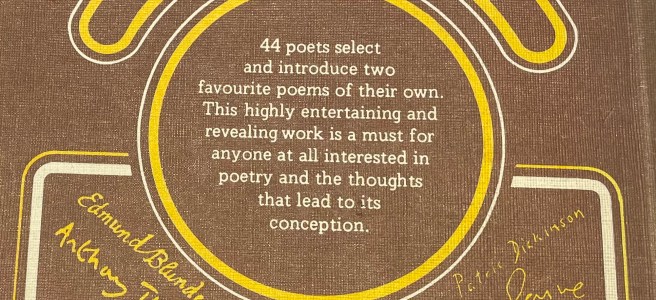
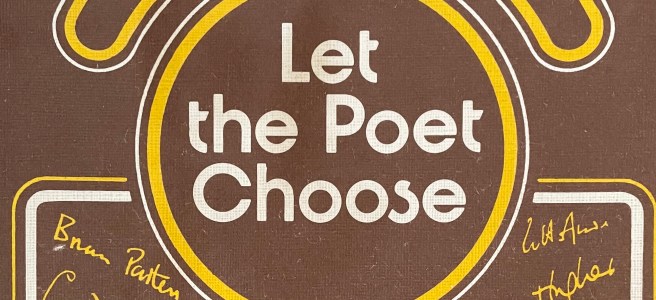
Let the Poet Choose, a 1973 British anthology in which each poet chooses two of their own poems and introduces them. As I said in my previous post, even where the poems don’t convince me, the prose can still be intriguing, the sound of poets trying to make sense of themselves. There are some interesting … Continue reading ‘Cleverer than I am, more lyrical than I am, more pessimistic than I am’
‘And when recalled they must bear arms again’
I have a liking for old poetry anthologies from secondhand shops, for saving them from oblivion, from the bottom of the poetry detritus pile. They are always a reminder of how precarious poetic reputations are, how little we know of who will last from our current favourites. I picked up ‘Let the Poet Choose’ (edited … Continue reading ‘And when recalled they must bear arms again’
‘He was mine before I was taught him’
The title quote is from Terrance Hayes, in his Paris Review interview. He’s talking about Yusef Komunyakaa: ‘I got a great deal from his work before I felt like I could explain what I was getting. He was mine before I was taught him’ It set me thinking - who were my poets before I … Continue reading ‘He was mine before I was taught him’
‘Dry the pool, dry concrete, brown edged’
A month ago I was staying in Chipping Campden, in the Cotswolds. Having read nothing about the village before I went there, I consulted the OS map. A mile to the north were the familiar words ‘Burnt Norton’; the old house that gave its name to the first of T.S.Eliot’s Four Quartets. Eliot visited the … Continue reading ‘Dry the pool, dry concrete, brown edged’