Richard Church is an almost-forgotten name now; minor poet, critic, novelist, editor of Dylan Thomas at Dent. I came across a book of his essays last weekend - Calm October, from 1961, secondhand, rather faded and worn. I flicked through and a couple of things caught my eye. He writes about his teenage poetry enthusiasms … Continue reading ‘The process by shy courtesy, with a touch of caution’
‘Reading the map afterwards/Assures us of our hinterland’
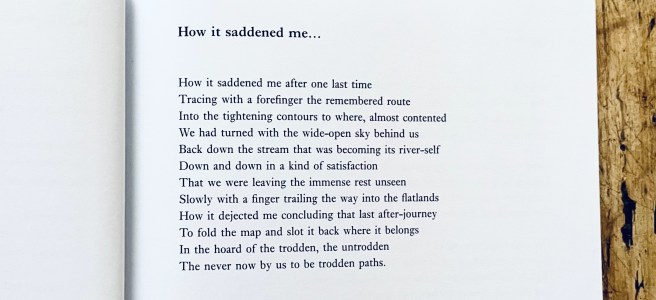
And more again about map-making and poetry. I’ve been reading section 1 of David Constantine’s ‘Belongings’. These half a dozen poems are a hymn of gratitude for walking, for the landscapes of Northern England and for the folded map. I’m reading them having just returned from walking Hadrian’s Wall and the Northumberland coast.The long lines … Continue reading ‘Reading the map afterwards/Assures us of our hinterland’
‘In Ilford High Road I saw the multitudes passing pale under the / light of flaring sundown’
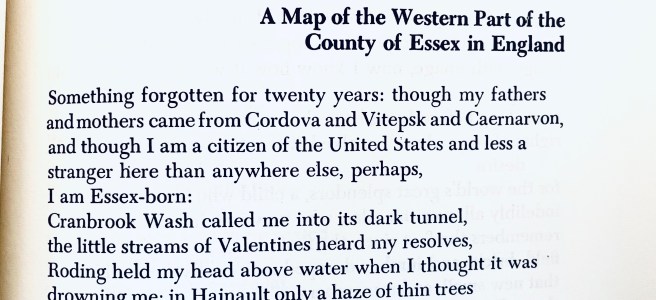
Sometimes, if I see an old poetry book going second-hand, I will buy the volume for the pleasure of seeing a favourite poem in its original form - font, paper, placement on the page and in the book. I have a thin copy of Denise Levertov’s ‘The Jacob’s Ladder’, a New Directions Paperbook (not paperback) … Continue reading ‘In Ilford High Road I saw the multitudes passing pale under the / light of flaring sundown’
‘Random thoughts in a casual manner’
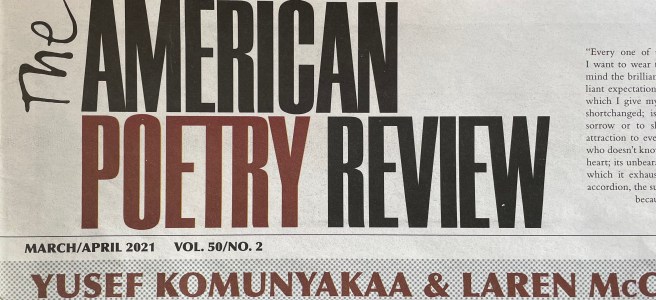
My thanks to the American Poetry Review for a concept - ‘zuihitsu’ - which, if I’ve understood it properly (and I’m not sure I have) has a lot in common with much modern poetry, not to mention blog-writing. It comes from an article by Kimiko Hahn called ‘The zuihitsu and the toadstool’. The definition she … Continue reading ‘Random thoughts in a casual manner’
‘It’s only when you talk to yourself that they prick up their ears’
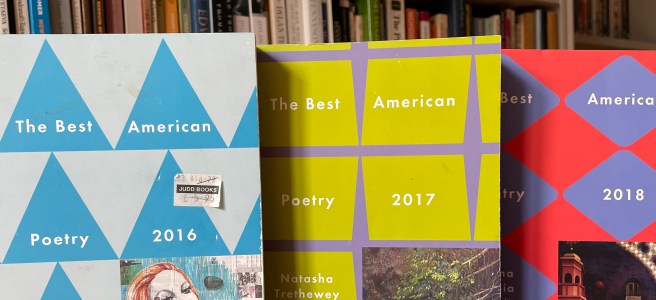
I like anthologies - to borrow or to buy cheaply, not often to keep. There are too many poets that don’t (in the end, after a few re-readings) interest me. But how else to find out what’s out there, what’s being written? And these are the anthologies I like best: the annual volumes of The … Continue reading ‘It’s only when you talk to yourself that they prick up their ears’
‘I will not waste my soul and my strength for this’
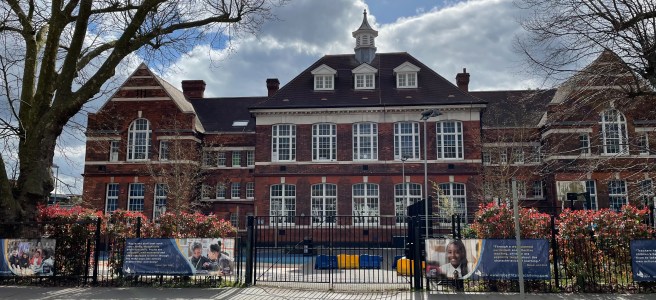
D.H.Lawrence taught here from 1908 to 1911, at Davidson Road Elementary School (as it was then called) in Croydon. It was a modern school in a fairly new suburb. The Victorian villas close by have dates from the 1890s engraved in the plasterwork. He was paid £95 a year to teach a class of 60. … Continue reading ‘I will not waste my soul and my strength for this’
The time is not ripe
The Peruvian poet Emilio Adolfo Westphalen, born in 1911, published his first two books in 1933 and 1935. They were highly successful. His next poems appeared after a silence of 45 years. During this time, if asked, he always said “The time is not ripe”. He seems never to have been translated into English, and … Continue reading The time is not ripe
I Will Tell You the Truth about This, I Will Tell You All about It
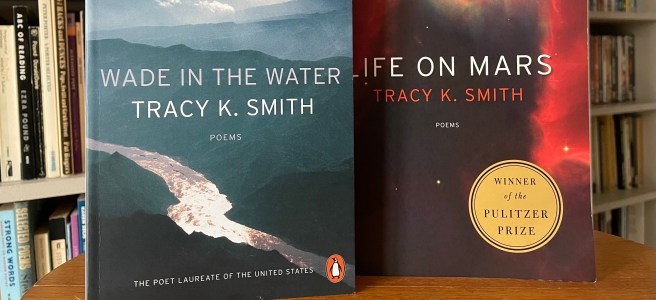
Tracy K. Smith’s ‘Wade in the Water’ (2018), her first UK publication, contains her powerful ‘erasure poems’, using historical texts from the American civil war. “I Will Tell You the Truth about this/I Will Tell You All about It” is a series of poems composed of letters and statements from African Americans enlisted in the … Continue reading I Will Tell You the Truth about This, I Will Tell You All about It
Mammocks
A lovely word, mammocks - ‘a scrap, shred, broken or torn piece’ (Oxford English Dictionary) which I owe to a Bookforum review of Ian Sansom’s 2013 book ‘Paper: An Elegy’. ‘Not quite a history, Paper feels more like a commonplace book, one of those predigital scrapbooks of items jotted down for future reference...... a magpie … Continue reading Mammocks
Reading Yeats on the El
This is the beginning and end of Lawrence Ferlinghetti’s Poem 12, from the section ‘Pictures of the Gone World’ in ‘A Coney Island of the Mind’ (1958), with its distinctive font, looking like it was designed on a typewriter. A poem has no obligation to be true, only convincing, but I’d be disappointed to find … Continue reading Reading Yeats on the El