A couple of weeks ago, Kathleen Jamie (whose poetry and prose I love) wrote a really interesting New Statesman review of ‘Islands of Abandonment: Life in the Post-Human Landscape’ by Cal Flynn. The book is about post-industrial wastes, contaminated landscapes, and how over time they become re-wilded, rich in bio-diversity. They change, in Jamie’s words, to something ‘fascinating, eerie and strange’ – ‘eventually nudging towards the optimistic’.
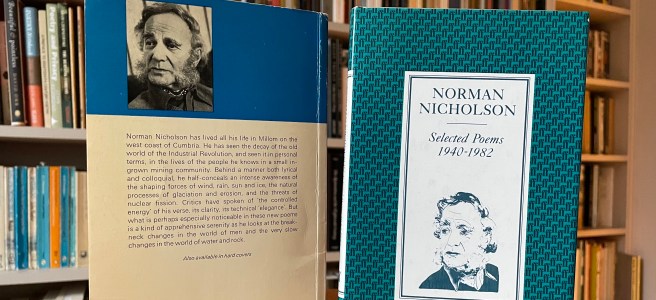
I want to claim Norman Nicholson (1914 -87) as a poet who used to notice such things. He lived almost all his life in Millom, an old industrial town on the coast to the south of the Lake District. He wrote about the exhaustion of quarries, the abandonment of coal and iron mines, and in particular the closure of Millom Ironworks in the sixties. It’s an elegiac account; it meant the loss of jobs belonging to family and friends, devastation for the town. But his poems are also a description of what comes after.
This is from ‘On the Dismantling of Millom Ironworks’
— mines
Drowned under stagnant waters, chimneys felled and uprooted,
Slagbanks ploughed down to half their height, all cragginess,
Scrag-end and scree ironed out, and re-soiled and greened over
To long sulky drumlins, dumped there by the look of them
An ice-age ago. They cut up the carcass of the old ironworks
Like a fat beast in a slaughter-house: they shovelled my childhood
On to a rubbish heap.
From ‘Weeds’
And they have their uses, weeds.
Think of the old, worked-out mines:
Quarries and tunnels, earth scorched and scruffy, torn-up
railways, splintered sleepers,
And a whole Sahara of grit and smother and cinders.
But go in summer and where is all the clutter?
For a new town has risen of a thousand towers,
Every spiky belfry humming with a pearl of bees.
And this from ‘Hodbarrow Flooded’
‘Where once the shafts struck down through yielding limestone,
Black coot and moorhen
Lay snail-wakes on the water’
I don’t think I would claim Norman Nicholson as an ecological writer; the sense of loss is too raw. He was a poet who lived through the traumatic withdrawal of heavy industry from a town built for that purpose. But if there was eventually a nudge towards the optimistic, he may have seen the beginning of it.

 the word-road home
Really interesting Dave. ‘Weeds’ made me think of the Dream sculpture on the site of the Sutton Manor colliery near St Helens. The biggest pit in the Lancashire coalfield, closed in 1991 and replanted by the Forestry Commission ten years later. When a public artwork was proposed, a group of ex-miners from the colliery worked with the Catalan artist Jaume Plensa; they rejected his first proposal for a representation of a miners’ lamp, as they wanted something that looked to the future, not just the past. They agreed on a 66-foot sculpture of a girl’s head and neck, looming above the trees next to the M62, eyes closed, in concrete and white Spanish dolomite (so the opposite of coal). I don’t know that I particularly like it as an artwork, but there’s definitely something in there about ‘nudging towards the optimistic’… (The working title was the old St Helens town motto Ex Terra Lucem – from the ground, light)
LikeLike
Thanks, Phil. I’ve looked at the online images of the sculpture. Slightly unnerving, I think; something about the self-contained interiority of the face, on such a large scale. Perhaps it looks different in situ.
LikeLike