At the beginning of October I was at the LRB bookshop for the launch of Sarah Howe’s new collection ‘Foretokens’. Towards the end a young woman at the front asked a really good question; it came from inexperience but was all the better for it. She said she’d only previously read the kind of poetry you read at school, and so didn’t know quite how to approach a book like this. Do you read from beginning to end? Do you pick and choose? How do you start?
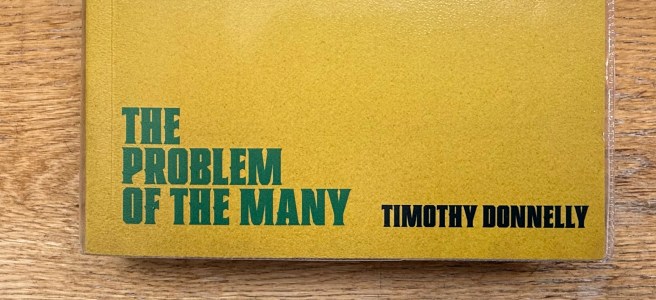
I’ve been thinking about the question in relation to the American poet Timothy Donnelly’s ‘The Problem of the Many’. It’s a chunky book for a single volume, and I’m a bit late to it – it was published in 2020 – but Donnelly only publishes about once every ten years (this is his third book) so it’s early days yet. Why read him? For the experience of a mind thinking, drifting, pondering, digressing, trying to take in everything that comes to his attention. And you read in order to ask yourself how he manages to get to the end of the poem, to get here from there, like a jazz solo, all over the place but ending up just right. And what does he think about? Well there’s quite a lot about environmental degradation, and about eating. One poem is titled ‘Lunch in a Town Named After a Company Slowly Poisoning its Residents’.
So how do you start? The problem of ‘The Problem of the Many’ is the number of really long and difficult poems; After Callimachus, Traveler, Hymn to Life (15 pages) and the title poem itself. I do start from the beginning, but initially I skip the troublesome ones. Low-hanging fruit first. There are plenty of short, well-constructed, memorable poems that give you a sense of how Donnelly’s maverick mind works; Stunt, Gifted, Smartwater, Wasted, All the Shrimps I Can Eat, Happiness, Insomnia. And ‘Jonah’, the shortest of all:
’If I don’t speak to
the darkness it
swallows me.’
After the short ones, some of the two or three page poems don’t seem too much of a stretch. You can hold them all in your mind, and if the attraction is about following how his thoughts wander, then greater length gives them more room to do so, like in ’The Stars Down to Earth’, ‘By Night with Torch and Spear’ or ‘What is Real’ which has this representative passage in its final stanza:
“In ‘America’, Baudrillard
says the products of our imagination remind us
what is real, the way weariness of existence is
how we come to feel, buried in all this abundance,
we are still alive. Hold on tight, my circumstance.
Tonight we’re diving in.”
Ian Penman, in his recent LRB article on Brian Eno, makes the case for art that doesn’t necessarily give immediate rewards: ‘It can make us feel good, but also bad, or baffled, or other emotions we may struggle to name. We’re not quite sure what it is we’re seeing or hearing or reading’. One way in to these poems, as they take on greater complexity, is to look for those passages where Donnelly seems to be describing what he’s trying to do;
‘……let us be, let being be, continuous, continuous
But when what
punishes us has penned itself in sleep, I reduce
what words it uses into a toxin I can sing
Here we are again I say but where exactly
nobody knows, that nowhere in particular humming between
one phoneme and a next….
Sometimes there’s a person who pretends to be talking
to another person or maybe he’ll just pretend to be
talking to another person idea or object as if it were a person
but in truth he’s not really talking to anyone or
-thing—he’s not even talking to himself, he’s only
writing. We pretend not to notice…’
That’s from four different poems; some people can’t stand this kind of stuff, poetry about poetry. I can, these passages feel like footholds to me, signposts telling me what to expect. Not just ‘this is what these poems are about’ but also ‘this is what it’s like to read (or write) this poem’.
Which doesn’t necessarily help when it comes to the four or five really long and challenging ones. They need energy, patience and time. I think I’ve made some headway with ‘After Callimachus’; it helps that it keeps returning to the idea of a sandwich or a burger (eating again) and that it’s written in sections – some structure there. And when it works the language takes you on and on until you don’t quite know where you’ve got to, or how you got there. As Donnelly says-
‘I know you don’t ordinarily
trust rhetoric like that, but I see
you have already taken my word for it.’
As for the other long poems, I’m not anywhere like that yet. I would adopt the words David Wheatley used some years ago, reviewing one of Geoffrey Hill’s late daybooks; ‘(readers) will find themselves bookmarking lines, stanzas and whole sections for renewed assault the next time around, in the endlessly renewed re-reading, rather than mere reading, the volume demands. Is this down to authorial hubris or the inexhaustible richness of (the) writing? Perhaps the two go together.’
I trust that the longer poems will, in time, become accessible to me. And if they don’t, there’s enough in this book to keep it on the shelf. Poetry reviews are always about the recent past, urging us to read (or ignore) what’s just been published. The real test of a contemporary book is whether we’re still reading it five or ten years later.

 the word-road home
Excellent and stimulating piece as always, Dave. I hadn’t come across Timothy Donnelly before so thank you for alerting me to him. But also very thought-provoking piece generally about not only about the nature of writing poetry but also or reading it. I’m forwarding it to Peter Carpenter who was in the year above me and a published poet and the author of Bowieland, recently published.
LikeLike