In a time of Trump, Gaza, Iran, I’ve been reading the 1950s novels of John Wyndham: The Day of the Triffids, The Chrysalids and The Midwich Cuckoos. It seemed apposite, all that post-apocalyptic fear, Cold War angst, the aftermath of a dreadful, unnatural mistake or catastrophe. And I wondered where that feeling went in the poetry of that period, dominated as it is by The Movement (Larkin etc), with its determined return to the ordinary, the undramatic, after what those poets saw as the rhetorical excess of the 1940s. D.J.Enright, of all of them, is most prepared to bring recent history into his poems; living in Japan, he makes sardonic reference to appalling tragedies in ‘Monuments of Hiroshima’ and ‘Apocalypse’. But one poem stands alone in the mid-50s in imagining a world after a new disaster; Edwin Muir’s ‘The Horses’. Whatever has happened, it’s recent:
Barely a twelvemonth after
The seven days’ war that put the world to sleep,
Late in the evening the strange horses came.
By then we had made our covenant with silence,
But in the first few days it was so still
We listened to our breathing and were afraid.
On the second day
The radios failed; we turned the knobs; no answer.
On the third day a warship passed us, heading north,
Dead bodies piled on the deck. On the sixth day
A plane plunged over us into the sea. Thereafter
Nothing. The radios dumb; ..”
The radio, the way you stayed in contact with the world in the early 50s. Contact not wholly to be welcomed, or welcomed back:
”If on the stroke of noon a voice should speak,
We would not listen, we would not let it bring
That old bad world that swallowed its children quick
At one great gulp.”
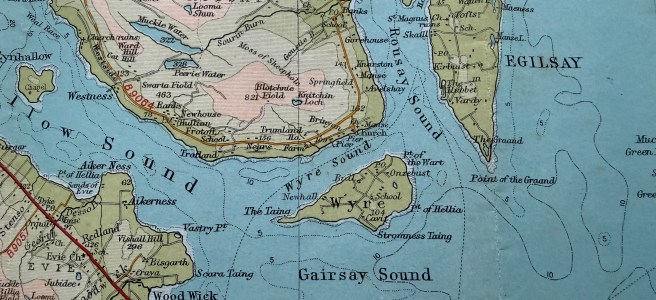
The horses are clearly creatures from his early childhood on Wyre, an Orkney island so small it had a handful of farms, no real roads, no jetty. This is a passage from ‘An Autobiography’:
”I felt beaten down by an enormous weight and a real terror, yet I did not hate the horses…. my fear turned into something else, for it was infused by a longing to go up to them and touch them and simultaneously checked by the knowledge that their hoofs were dangerous… Everything about them, the steam rising from their soft, leathery nostrils, the sweat staining their hides, their ponderous, irresistible motion, the distant rolling of their eyes….. the waterfall sweep of their manes, the ruthless flick of their cropped tails, the plunge of their iron-shod hoofs striking fire from the flagstones, filled me with a stationary terror and delight for which I could get no relief.”
But, although they are the future – ‘their coming our beginning’ – the horses are also semi-mythical, something out of a children’s book or epic poem, an old, buried story:
”We had sold our horses in our fathers’ time
To buy new tractors. Now they were strange to us
As fabulous steeds set on an ancient shield
Or illustrations in a book of knights.
We did not dare go near them. Yet they waited,
Stubborn and shy, as if they had been sent
By an old command to find our whereabouts
And that long-lost archaic companionship.”
I’ve read that the poem was a staple of the curriculum in Scottish schools for a long time, which would make it very hard to love, but having not had that disadvantage I find it compelling. It’s a sort of magical, ecological picture of a new start after the very worst has happened.
As for the rest of Muir’s poetry, I wish I liked it more than I do. His biography is fascinating; early childhood in the Orkneys, the move to Glasgow when he was 14, death of his father and two brothers, self-education through Guild Socialism and the Independent Labour Party, marrying Willa (a teacher trainer, who worked later in A.S.Neill’s experimental school, Summerhill), moving to Prague where they co-translated Kafka. But the interest of the life-story doesn’t guarantee that the poetry will last.
Muir’s reputation was at its highest in the late 40s and 50s. In 1963, Louis MacNeice gave a Clark Lecture in Cambridge on the subject of contemporary poetry and drama, discussing Eliot, Auden, Muir, Ibsen, Beckett and Pinter. Not many would put Muir in that company now. Even his defenders have sometimes been a little half-hearted. Kenneth Allott called him an ‘extremely honest and often rewarding but not exciting poet’. John Holloway, a friend of Muir’s in the late 50s (Muir died in 1959) referred to his ‘grave and lucid rhythms… the honesty and spareness of his diction’. When Mick Imlah wrote an introduction to a Faber selection 20 years ago, he said the poems were ‘not designed to delight or move the reader’. Muir himself feared a decline in his standing; in his autobiography he records a dream – “A friend of mine had written an enthusiastic review of a volume of my poems; a week or two later, having thought them over more carefully, he reviewed them again, coldly; then, after an interval, he reviewed them again, and had hardly a word to say for them. A vague apprehension that he might go on reviewing them for ever, in a steady scale of depreciation, sometimes came into my mind…”. (This must be the secret fear of many writers, a version of the classic exam dream where you have to keep on retaking what you’ve already passed)
But the enthusiastic reviews were still coming in 1956, when he published ‘One Foot in Eden’, the volume that contains ‘The Horses’ (I have John Holloway’s copy, which I found in a secondhand bookshop on Charing Cross Road). He was regarded as an important influence on the poets of The Movement, on Elisabeth Jennings in particular. And I would say there are at least half a dozen poems that have lasted, which don’t require any special pleading. There is ‘Childhood’ for instance:
”Grey tiny rocks slept round him where he lay,
Moveless as they, more still as evening came,
The grasses threw straight shadows far away,
And from the house his mother called his name.”
There are ‘The Interrogation’ and ‘The Good Town’, two important poems of Cold War anxiety. ‘Milton’ stands out, the first poem of ‘One Foot in Eden’, about the blind poet reaching heaven via what sounds a little like Muir’s memories of Glasgow:
(he) “heard the steely clamour known too well
On Saturday nights in every street in Hell.
Where, past the devilish din, could Paradise be?
A footstep more, and his unblinded eyes
Saw far and near the fields of Paradise.”
The one I’m memorizing is also from that volume – ‘The Late Wasp’:
’You that through all the dying summer
Came every morning to our breakfast table,’
This poem, like The Horses, can be traced back to Muir’s early childhood, a memory of living at a different scale to the adults around him:
”I lived my life in a small, separate underworld…. for most of the time I lived with whatever I found on the surface of the earth: the different kinds of grass, the daisies, buttercups, dandelions, bog cotton (we did not have many flowers), the stones and bits of glass and china, and the scurrying insects which made my stomach heave as I stared at them, unable to take my eyes away.”
For committing to memory, it helps that the poem is close to sonnet form – 14 lines, rhymed (The Horses is a page and a half, unrhymed); rhyme undoubtedly assists the ear to anticipate, or at least know whether the end of the line could be correct. I also find that the better the lines, the easier to keep in my head. And the second half of the poem (the last eight lines) is, in its own minor way, beautiful and poignant:
”You and the earth have now grown older,
And your blue thoroughfares have felt a change;
They have grown colder;
And it is strange
How the familiar avenues of the air
Crumble now, crumble; the good air will not hold,
All cracked and perished with the cold;
And down you dive through nothing and through despair.”
From world-wide disaster to small, insect-sized apocalypse.


